
Houston County Parole or Probation
Probation, formally called community supervision in Texas, is ordered by a court instead of, or after part of, a jail or prison term. Houston County Community Supervision and Corrections Department, or CSCD, manages adult cases imposed by local courts. A person can finish Houston County probation without ever entering a Texas Department of Criminal Justice prison.
Parole is conditional release from a TDCJ prison before the sentence fully ends. The Texas Board of Pardons and Paroles, or BPP, makes the release decision and sets special conditions. The TDCJ Parole Division then carries out supervision. Neither agency is Houston County CSCD. A person released on parole may live in Houston County and report to a state district parole office, while a probation client reports through the county system.
| Question | Houston County probation | Texas parole |
|---|---|---|
| How it starts | Local court orders community supervision | BPP approves conditional prison release |
| Who supervises | Houston County CSCD | TDCJ Parole Division |
| Public name search | None published by CSCD | TDCJ offender and parole-review information |
| Local routing office | Crockett CSCD office | Huntsville District Parole Office, subject to assignment |
| End point | Court-ordered term ends or court discharges it | TDCJ discharge after the applicable sentence and supervision term |
- Parole
- Conditional release from state prison while a sentence remains active.
- Probation
- Court-ordered supervision in the community, called community supervision in Texas law.
- Discharge
- The end of the applicable custody or supervision term, not merely release from a building.
- Absconder
- A person alleged to have stopped reporting or left supervision without permission.
Verify Houston County Post-Release Supervision
Start with the court and custody trail, not a guess based on where the person lives. The Houston County released-inmate search path helps establish whether the person left the county jail, entered TDCJ, or received a community-supervision sentence. Then use the agency tied to that event. A no-result from one system does not answer what another agency holds.
- Confirm identity and case. Match the full name with a case number, date of birth, TDCJ-CID number, or booking number. Same-name results are not enough.
- Read the judgment. A Houston County court record can show whether the sentence includes probation, confinement, or a revocation. It does not by itself prove the exact jail exit time.
- For probation, contact CSCD. Provide the case number and ask what public information the office can confirm. CSCD offers no public person-name lookup.
- For parole, check TDCJ and BPP. Use the offender detail and parole-review information, then confirm the assigned state office when needed.
- Separate approval from release. A favorable BPP vote may still require a certificate, program, plan, or other processing before release.
- Confirm discharge. Read the field label and date. Leaving prison on parole is not the same as finishing the sentence.
Houston County Supervision Offices
The correct contact depends on the sentence. The Houston County CSCD page gives a concrete route for local probation. Houston County is routed to Huntsville for state parole, not to a similarly named Houston metropolitan office. Residence and transfer decisions can change a particular parole assignment, so the district listing is a starting point rather than proof of where one person reports.
Houston County CSCD
110 North 2nd Street
Crockett, TX 75835
936-545-0005
Supervisor Yanira Garcia, ext. 224
Administrative contact Cheryl Terrell, ext. 221
Transfer clerk Melanie Goolsby, ext. 226
Probation officer John Esposito, ext. 225
Huntsville District Parole Office, Region I
600 Interstate Highway 45 North
Huntsville, TX 77320
936-295-5217
Fax: 936-435-2603
The official Huntsville district listing confirms the state office details. Ask only for information available to the public and use the known TDCJ identifier whenever possible.
The official CSCD screen shows the named local contacts and Case Connect route. View the Houston County supervision source before relying on an old directory.
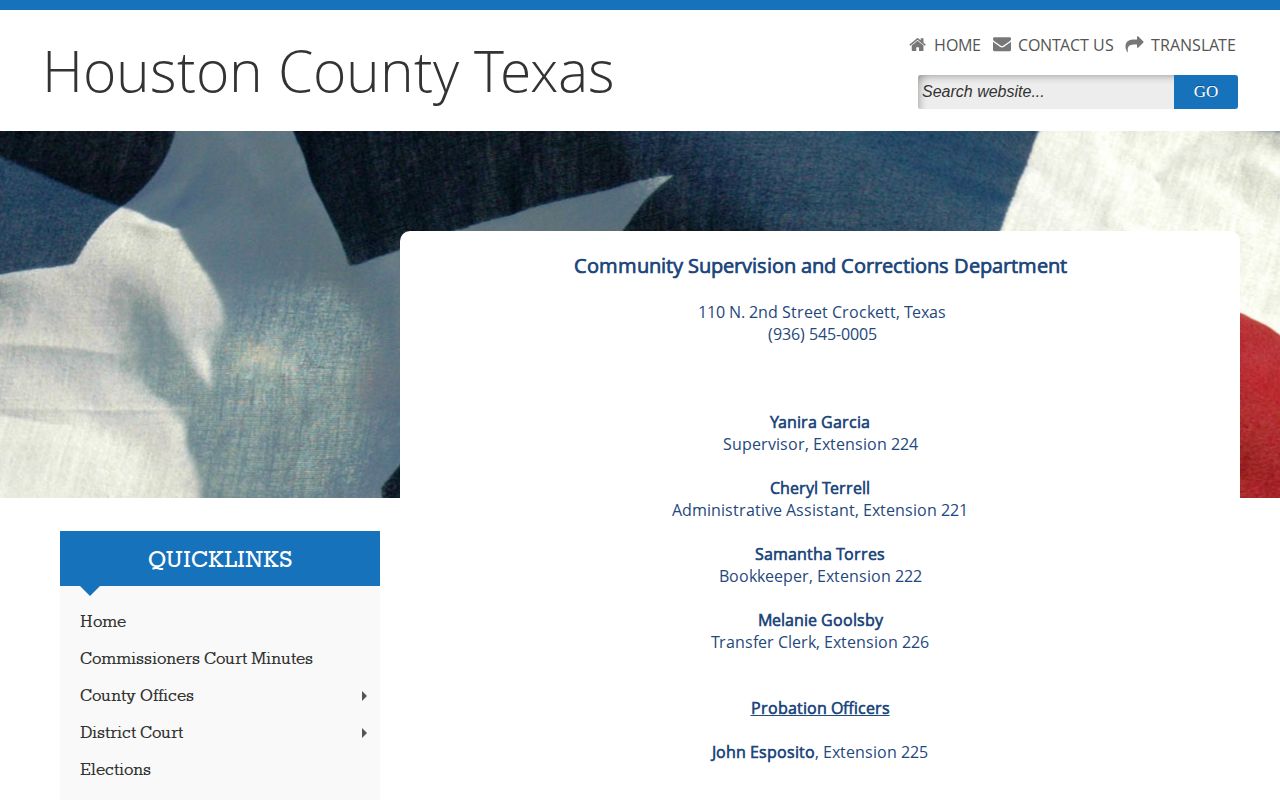
The image helps distinguish the county probation office from TDCJ parole channels used after a state-prison release.
Houston County Supervision Status Changes
Conditions are the rules attached to supervision. They may include reporting, treatment, travel limits, or other terms in the controlling order. The supervising officer manages compliance, but the body with legal authority decides the result of a charged violation. For parole, BPP decides revocation and special conditions. The Parole Division supervises and investigates; it does not make those decisions.
An absconder label generally means the agency alleges that the person stopped reporting or left supervision without permission. It does not explain the full case. TDCJ policy identifies warrant number and date, parole or mandatory-supervision status, officer name, offense and sentence facts, parole or mandatory-release dates, and discharge dates among fields that may be publicly supplied. A precise request can therefore resolve more than a loose name search, subject to confidential-record limits.
TDCJ IVSS can provide registered notices for BPP decisions, prison release, discharge, and return to custody. Texas IVSS Counties serves participating county custody and court events. Read each event label. A transfer notice, warrant, or return-to-custody event is not a new discharge.
Note: Verify a warrant or alleged violation with the issuing authority because an old status screen may not show the final disposition.
Houston County Supervision and Discharge
Supervision ends through the action and date recorded by the responsible system. On probation, the court record may show completion, early termination, revocation, or another order. On parole or mandatory supervision, the TDCJ record supplies the state status and discharge date. “Released” means leaving a custody setting; “discharged” can mean the end of the legal custody or supervision term. The labels should never be swapped.
Texas Government Code chapter 508 governs parole, but eligibility is not release. Offense date, sentence, and statutory category affect when a file may be reviewed. For some listed serious or deadly-weapon cases, section 508.145 uses actual-time thresholds and does not let good time reduce the stated minimum. The correct step is to read the person's official eligibility and decision fields, not calculate a date from a general rule.
A Houston County court docket can outlast roster and supervision displays. Obtain the actual judgment or discharge order when the legal result matters. For TDCJ, a records request with the TDCJ-CID or SID number can seek the existing public release and supervision fields. The agency record is stronger than an alert alone.
Houston County Parole File Votes
Ordinary Texas parole consideration is usually not a formal public hearing. BPP's official panel-review guidance says panel members vote the case file one at a time. An optional panel-member interview is not a parole hearing, and its date is not a prison release date.
The Parole Division identifies a file before eligibility or a later review date. An institutional parole officer interviews the prisoner and prepares a case summary. Three voters act in sequence, and two matching votes make the result final. A denial sets later review terms; approval can include a program or special condition. Codes such as FI, NR, and SA must be read from the current BPP legend, not simplified into “released” or “denied forever.”
Results are person-specific. Use TDCJ's inmate detail and parole-review display or call the BPP Parole Status Line at 844-512-0461 with the name, TDCJ-CID number, or date of birth. BPP result guidance also warns that a favorable decision may be reconsidered. After approval, the Huntsville Placement and Release Unit still processes the certificate. Review and Release Processing is listed at 512-406-5449 for release-status questions.
The official result screen explains how to locate a vote without treating it as a completed release. Review the BPP result source for the current method.
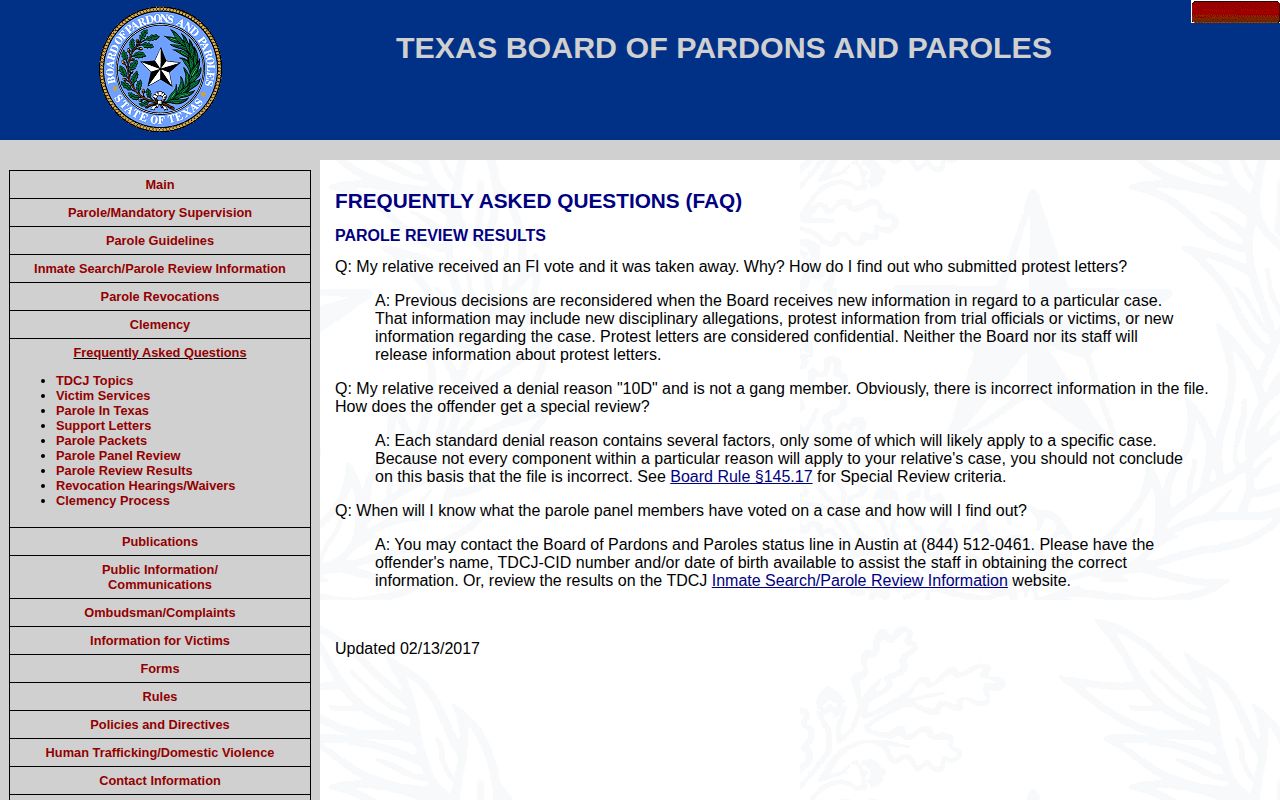
The displayed process belongs to BPP decision records, while field supervision remains the work of the Parole Division.
Houston County Reentry Routes
Houston County's local probation route includes named staff, a transfer clerk, and Case Connect. The app is for a client to connect with a case. It is not a public search for released people. Someone trying to verify supervision should use the office contact and case identifier instead of attempting to look up another person through the app.
J. Dale Wainwright Unit lists CHANGES/pre-release and reentry planning among its prison programs. Those services belong to TDCJ's state-prison process and should not be confused with Houston County CSCD. A person can receive prison reentry planning and later report to the Huntsville parole office, while a separate person may begin probation through a Houston County court without any Wainwright or TDCJ custody.
This local split is useful when records seem to conflict. Identify the sentencing court, the last custodian, the release type, and the current supervising agency. That four-part chain shows whether the next call belongs to CSCD, BPP, the TDCJ Parole Division, or a records office.