
Four Houston County Release Dates
TDCJ records can place four dates near one another, but they do not answer the same question. A parole eligibility date opens a legal review point. A projected release date is TDCJ Classification and Records' calculation of when the inmate may leave incarceration if parole does not happen sooner. A scheduled release date appears after approval and certificate processing have moved further along. A discharge date or maximum-expiration date marks completion of the applicable legal sentence or supervision term absent a different lawful event.
| Date label | What it means | What it does not prove |
|---|---|---|
| Parole Eligibility Date | The point when BPP may legally begin review under the governing offense and sentence rules. | It is not an approval or an exit date. |
| Projected Release Date | TDCJ's calculated mandatory-supervision or discharge projection if parole does not occur first. | It is not proof the person left prison. |
| Scheduled Release date | A date posted after approval and release-certificate processing have advanced. | It can still change without notice. |
| Discharge or Maximum Expiration | Completion of the legal sentence or supervision term under the field's stated context. | It is not an early-release estimate. |
A favorable BPP decision coded as an FI is approval for future release under the stated terms. It is not the physical exit time. Likewise, release from prison on parole means the person left the institution but did not yet discharge the sentence. Keep the four labels separate when saving or sharing the record.
Find a Houston County Projection
Use the TDCJ Online Offender Search for a person serving a Texas prison sentence. A TDCJ number or State Identification number is the strongest search key. If neither is known, search by exact surname and given name, then compare offense, county, sentence, and available identity details. A same-name match is not enough.
- Determine whether the person is in Houston County Jail or TDCJ custody. The systems publish different records.
- Run the TDCJ search with the TDCJ or SID number when possible, or use exact name fields and careful narrowing.
- Open the matching person's Offender Information Details Screen and copy each date with its label.
- Scroll for a Scheduled Release date and Scheduled Release location if release processing has reached that stage.
- Save the observation date, then recheck the official detail record as the projected or scheduled date approaches.
- If the online display is incomplete, use TDCJ's email or telephone information channel and supply the best identifiers available.
The TDCJ inmate-information hub describes online, email, and telephone routes. Its email instructions say a request to pia@tdcj.texas.gov should include the full name and seven-digit TDCJ number. If the number is unknown, provide the exact date of birth, or approximate age and county of conviction when even the birth date is not known. TDCJ says that no-charge service may provide the TDCJ number, location, conviction information, prior incarceration history, and projected release date.
The official search form shows the state fields used to start that match.
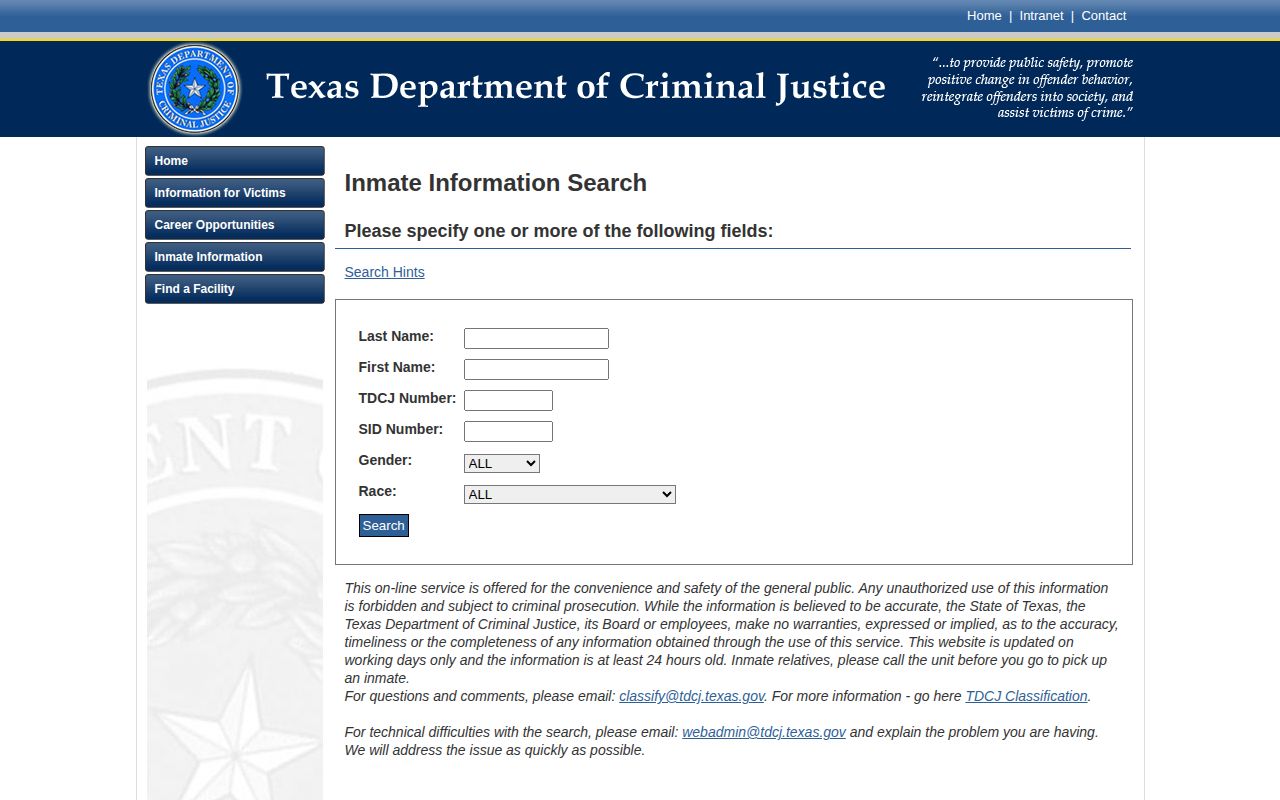
A correct TDCJ match links the date to the state-prison record rather than to every Houston County Jail booking.
Houston County Jail Release Timing
The TDCJ formula should not be applied to a Houston County Jail stay. A person held before trial has no set release day merely because a charge or bond appears on the current roster. Bond action, a court order, case disposition, time credit, another agency's detainer, or transfer can control what happens next. The HCSO current-inmate list does not publish a projected release field.
For a county sentence, use the sentencing judgment, the Sheriff's existing time-credit calculation, and the governing law or local policy. HCSO publishes no county good-time formula or weekend-release rule on the official pages reviewed. Ask for the actual calculation instead of estimating from the sentence. A focused request should identify the person and booking, then seek the release date and time, release disposition, time-credit computation if one exists, and any destination or receiving agency.
The local court docket can explain a bond, dismissal, plea, judgment, sentence, credit, or revocation. It may not show the minute that HCSO released or transferred the person. The Houston County release-record search joins the jail, court, and receiving-agency channels without treating absence from the live roster as an exit record.
Note: A missing HCSO roster card is only a lead because the public list has no release date, reason, or archive.
Texas Good Time Rules
Texas Government Code section 498.003 governs state-prison good-conduct time. The law calls good time a privilege, not a right. It affects eligibility for parole or mandatory supervision under the cited release statutes and does not otherwise shorten the judicial term. Credits depend on classification, conduct, and participation, and they may be forfeited.
The statute generally allows 20 days of good time for each 30 days actually served by trusty and Class I classifications, with up to ten more trusty days. Class II generally earns ten days per 30 days served. Class III or an excluded status earns none. These rates do not authorize a reader to calculate a firm release day because offense rules, sentence credit, classification changes, BPP action, and agency processing still matter.
- Flat time
- Actual calendar time served in custody.
- Good time
- A conditional state credit used in specified eligibility calculations, not a reduction of the sentence itself.
- Mandatory supervision
- A supervised form of release governed by offense-date, eligibility, time-credit, and approval rules.
- Parole
- Conditional release from prison after BPP approval, with part of the sentence still under supervision.
The TDCJ definitions page gives the official meaning of its projected-release field.
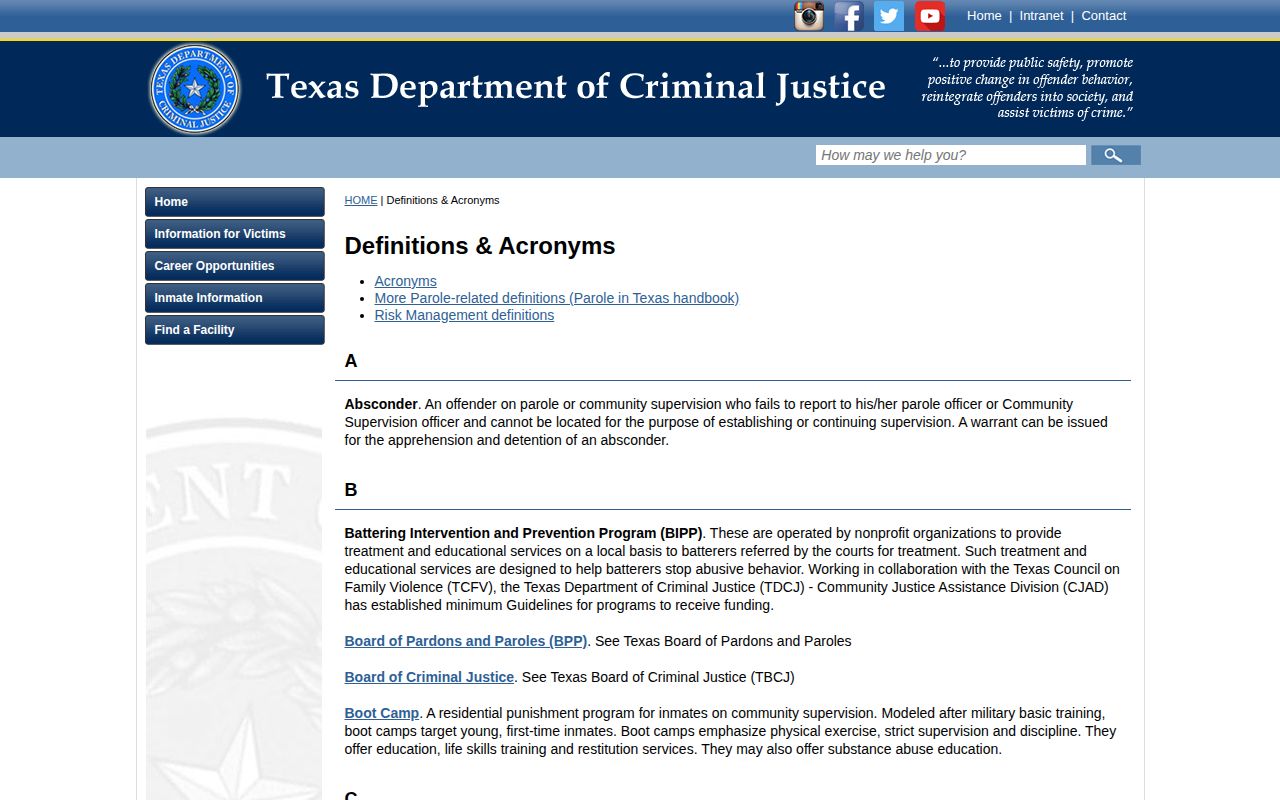
Those definitions apply to TDCJ records, including a prisoner at J. Dale Wainwright Unit, but not as a shortcut for a county-jail calculation.
No General Texas 85% Rule
Texas does not have a general law requiring every prisoner to serve 85 percent of a sentence. Applying that percentage across Houston County cases is wrong. The serious-offense parole threshold commonly confused with such a rule is different. Government Code section 508.145(d), with its cross-reference to Code of Criminal Procedure article 42A.054 and deadly-weapon findings, generally requires actual calendar time equal to one-half of the sentence or 30 years, whichever is less. When the sentence is under four years, the minimum is two calendar years. Good time does not cut that flat-time threshold.
Many other cases use a different parole-eligibility computation. Under the applicable part of section 508.145, actual time plus good-conduct time may need to reach one-fourth of the sentence, subject to a 15-year cap and the rules tied to the offense and offense date. Special provisions cover capital, aggravated sexual, trafficking, continuous sexual abuse, consecutive-sentence, and other cases. Section 508.149 separately lists categories that cannot use mandatory supervision.
Eligibility permits review. It does not create a right to parole, set the physical exit day, or cut the sentence. Article 42A.054 is also the current citation for the category once commonly called “3g” offenses. Do not use “3g” as a loose label for every violent offense.
How TDCJ Projects Release
TDCJ defines Projected Release Date as the date calculated by its Classification and Records Office on which the inmate is projected to leave incarceration if not paroled sooner. The offense title and offense date affect the method. For an eligible offense committed before September 1, 1996, the mandatory-supervision projection is when flat time plus good time equals the sentence.
For an eligible offense on or after that date, mandatory supervision is discretionary. Flat time plus good time must equal the sentence, and BPP must approve release. If BPP denies mandatory supervision, TDCJ recalculates the projection to maximum expiration or discharge. A later approval can move it earlier for processing. For a person not eligible for mandatory supervision, projected release generally equals maximum expiration based on flat time unless parole happens first.
This is why a generic calculator can mislead. It may not know the correct offense-date law, sentence credit, current time-earning class, stacked sentences, detainer, BPP decision, or required program. TDCJ Classification and Records maintains prison-sentenced records, calculates inmate time, places detainers, and facilitates transfers and releases. Its current calculation controls the public field.
Why Houston County Dates Move
A projected or scheduled date can change for lawful reasons. Compare the old and new label, check whether the source changed, and ask the responsible agency for its current computation when timing is critical. Do not perform simple sentence arithmetic and promise an exit day.
| Change | Possible effect on release timing |
|---|---|
| BPP approval or denial | Parole or mandatory-supervision action may move release earlier, keep it under review, or push projection to maximum expiration. |
| Time-earning classification | A new class changes the rate at which applicable good time is earned. |
| Forfeited or restored credit | Discipline or later restoration can alter an eligibility calculation. |
| Sentence-credit correction | A revised custody-credit total changes the base used by Classification and Records. |
| New judgment or consecutive term | A modified or added sentence can change the controlling expiration and review dates. |
| Detainer or hold | Another agency may take custody even when TDCJ closes its own release event. |
| Required program | A release condition can depend on completion and available placement. |
| Certificate processing | Audits, approval documents, and release-location work can shift a scheduled day. |
Note: TDCJ warns that even a scheduled release date may change without notice, including on the date shown.
Confirm Houston County Actual Release
A future date should be rechecked after it passes. Save the matching identifiers, offense and county, status, and exact projected, scheduled, parole, release, or discharge labels. If release information is absent, TDCJ's public guidance says the inmate has not been scheduled for release at that time. The omission should not be replaced with a guess.
For a parole or mandatory-supervision exit, compare the state detail record with TDCJ IVSS and the supervision channel. TDCJ IVSS covers people in state custody or on parole or mandatory supervision. Houston County is routed to the Huntsville District Parole Office, though a person's actual assignment can change with residence or transfer. BPP decides release; the TDCJ Parole Division manages supervision operations. A vote and an actual prison exit remain different events.
Use VINELink Inmate Search for the current distinction between Texas IVSS Counties and TDCJ IVSS. County IVSS can report that HCSO transferred a person to TDCJ. TDCJ IVSS then follows state custody and parole events. For completion of the legal term, confirm the discharge field or obtain a TDCJ response. For a Houston County Jail exit, seek the HCSO release or transfer record instead.